The Titan's widow in exile: María Cabrales and a receipt from La Mansión
Seven lines of ink, dated in Costa Rica in April 1898, tell how Antonio Maceo's wife survived while the war he had died for was being decided.
Some documents are written for history: proclamations, war dispatches, letters to presidents. Others are written to cover the month. This one belongs to the second group, and perhaps that is why it says so much.
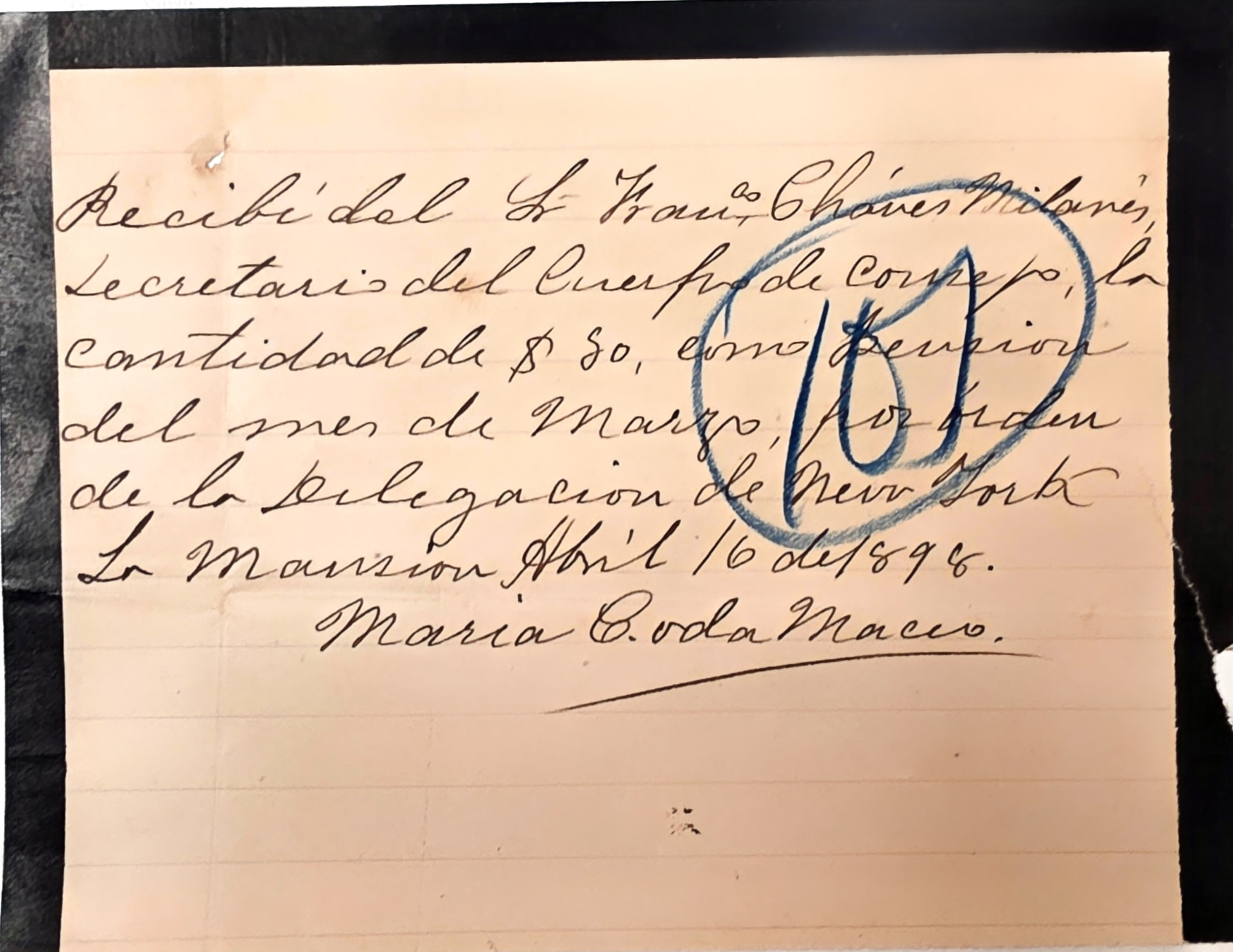
It is a sheet of ruled paper, written in careful handwriting: «Received from Mr. Franco. Chaves Milanés, Secretary of the Cuerpo de Consejo, the sum of $30, as the pension for the month of March, by order of the New York Delegation. La Mansión, April 16, 1898. María C. widow of Maceo.»
The signer is María Cabrales, widow of Major General Antonio Maceo, the Bronze Titan. The place, La Mansión, is a corner of the Nicoya peninsula in Costa Rica. The date, April 16, 1898, falls in one of the tensest weeks in Cuban history.
The woman behind the Titan. María Magdalena Cabrales Fernández was born in Santiago de Cuba in 1842 and married Antonio Maceo in 1866. She was no wife waiting at home: she followed her husband through the Ten Years' War and then a long exile across Jamaica, Honduras, Panama and Costa Rica.
In Costa Rica she did more than accompany him. In 1894 she founded a Cuban women's club to raise funds for the new war of independence and worked closely with José Martí to prepare the uprising. For the Cuban émigrés of Central America, her home was also an organizing hub.
La Mansión: a Cuban colony in Nicoya. La Mansión was born in 1891, when Maceo obtained land in Nicoya from the Costa Rican government to found an agricultural colony of Cuban families. Veterans of the previous war settled there with their families, in a project that was both livelihood and rearguard for the cause.
Maceo left Costa Rica for Cuba in 1895 to join the new war. He would never return: he was killed in combat at Punta Brava, near Havana, on December 7, 1896.
A widow without means. Maceo's death left María Cabrales in a difficult position. According to her biographies, in September 1897 she returned to La Mansión to support herself. She did not withdraw from public life: there she was elected treasurer of the women's club «Cubanas y Nicoyanas».
The receipt fits that moment exactly. Seven months after returning to Nicoya, María Cabrales signs that she has collected the March pension. The widow of the war's most famous general depended on a monthly allowance from the independence movement.
Who paid: the Cuban Revolutionary Party network. The receipt names three parts of a machine Martí had built and that outlived him.
The New York Delegation. After Martí's death in 1895, Tomás Estrada Palma led the Delegation of the Cuban Revolutionary Party from New York: diplomacy, propaganda, expeditions and money. The pension was paid «by order» of it.
The Cuerpo de Consejo. In every town with Cuban émigrés, the Party's patriotic clubs were grouped into a Cuerpo de Consejo, the local link that received and carried out the Delegation's orders.
Francisco Chaves Milanés, secretary of that Cuerpo de Consejo, handed over the money. For now, we know nothing more about him.
That this circuit still worked in April 1898, in the final stretch of the war, says a lot about the émigrés' administrative discipline. Institutions such as the University of Miami's Cuban Heritage Collection hold receipts of the same kind, and CUVINTAGE holds another from the same family: an 1897 Party Treasury receipt signed by Benjamín Guerra.
Three days before the war. The date is no ordinary one. The battleship Maine had exploded in Havana harbor in February. On April 19, 1898, three days after María Cabrales signed this paper, the U.S. Congress passed the Joint Resolution that opened the war with Spain.
While Washington decided Cuba's future, in Nicoya Maceo's widow collected her March pension. The contrast between grand history and daily life is what makes this document valuable. María Cabrales returned to Cuba in May 1899 and died in Santiago de Cuba in 1905.
What we still don't know. The amount: the most likely reading is 30 dollars, but the first digit could be different; a magnified examination will confirm it. Francisco Chaves Milanés: we have found no published information about him or his Cuerpo de Consejo, probably that of Costa Rica. The blue number: a later number in blue pencil, circled, crosses the text; it is probably an archive or accounting mark, and the same mark appears on the 1897 receipt.
If you have information about Francisco Chaves Milanés or the La Mansión colony in 1897–1898, we would love to hear from you. The receipt is part of the CUVINTAGE collection and is for sale.