The Decree That Gave Rise to the Hay-Quesada Treaty
A manuscript decree signed by Tomás Estrada Palma in February 1904 appoints Gonzalo de Quesada to negotiate the Isle of Pines with the United States.
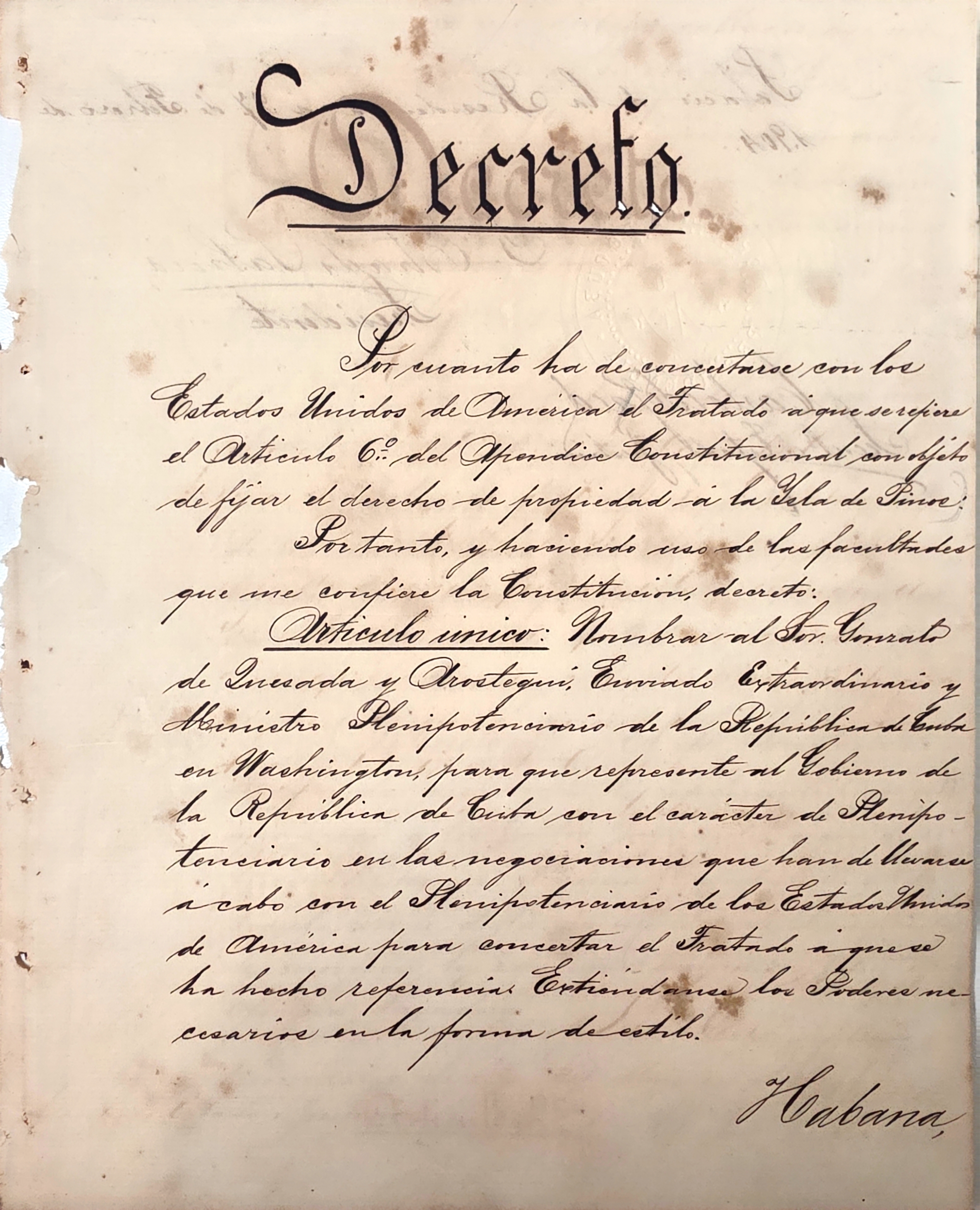
Tomás Estrada Palma signed it on February 27, 1904. The United States Senate took 21 years to approve what came next. The ink of the word "Decreto" is so heavy that it has eaten through the paper in two places. The letters are large and gothic, in a clerk's hand, and they head a single leaf written on both sides at the Presidential Palace in Havana. On the back are two signatures. The first reads "T. Estrada Palma, Presidente". The document is dated February 27, 1904 and has one article. It appoints Gonzalo de Quesada, Cuba's minister in Washington, to negotiate a treaty with the United States over the Isle of Pines. Four days later, Quesada signed it. A republic missing its second island Cuba had been a republic for less than two years and its map was still unsettled. The Platt Amendment, which Washington required Cuba to write into its 1901 Constitution, gave its sixth article to the Isle of Pines: the island stayed outside Cuba's boundaries until a treaty decided whose it was. The decree says so in the language of its day. The treaty is to settle "the right of ownership of the Isle of Pines". It had been tried before. On July 2, 1903 the two governments signed two treaties on the same day. One leased Guantánamo to the United States. The other recognized the Isle of Pines as Cuban. The Cuban Senate approved both two weeks later. The United States Senate approved the Guantánamo lease and let the deadline on the other run out. Washington had its naval base. The island still had no recognized owner. Four days The signing had to be done again, and for that Quesada needed new powers. He was the first minister Cuba sent to Washington. Years earlier he had worked alongside José Martí, who entrusted him with his papers before he died. The text that empowers him fills one side of the leaf. In translation: Sole article: To appoint Mr. Gonzalo de Quesada y Aróstegui, Envoy Extraordinary and Minister Plenipotentiary of the Republic of Cuba in Washington, to represent the Government of the Republic of Cuba, with the character of Plenipotentiary, in the negotiations to be carried out with the Plenipotentiary of the United States of America to conclude the Treaty referred to. "Let the necessary Powers be issued in the customary form," it ends. Below the president's signature is that of Carlos de Zaldo, Secretary of State and Justice. On March 2, 1904, in Washington, Quesada and Secretary of State John Hay signed the new treaty. This time it carried no deadline. The wait With no deadline, the treaty could no longer lapse. Nobody was in a hurry to vote on it either. It spent 21 years in the United States Senate. In that time American citizens came to own most of the island's land, although they were a minority of the people living there. Hay died in 1905. Estrada Palma left the presidency in 1906 and died in 1908. Quesada died in 1915. The Senate ratified the treaty on March 13, 1925. The island is now called Isla de la Juventud. The leaf that authorized the negotiation still carries both signatures and the embossed seal of the Republic, and is part of the CuVintage catalogue.