How to read an old manuscript: a telegram to Puerto Príncipe, step by step
A sheet of cramped handwriting, a stain, a hole and a signature without a surname. This is how we turned it into readable text, and how we decided what we cannot claim.
When a handwritten document reaches CUVINTAGE, the first task is not to value it or find it a buyer: it is to read it. It sounds obvious, but it isn't. Nineteenth-century handwriting, abbreviations, corroded ink and damaged paper turn many sheets into a puzzle.
This article shows the process with a real case: a small sheet that, at first, we didn't even know what it was.
Step 1. Put the document the right way up. The first photograph was sideways. It seems a detail, but reading slanted handwriting by tilting your head is the surest way to get it wrong. The first thing was to rotate the image and raise the contrast in greyscale, which separates the ink from the stains on the paper.
With a physical document, the equivalent is good diffuse daylight, a magnifying glass and sometimes raking light: a low, side lamp that reveals faint strokes and dry seals.
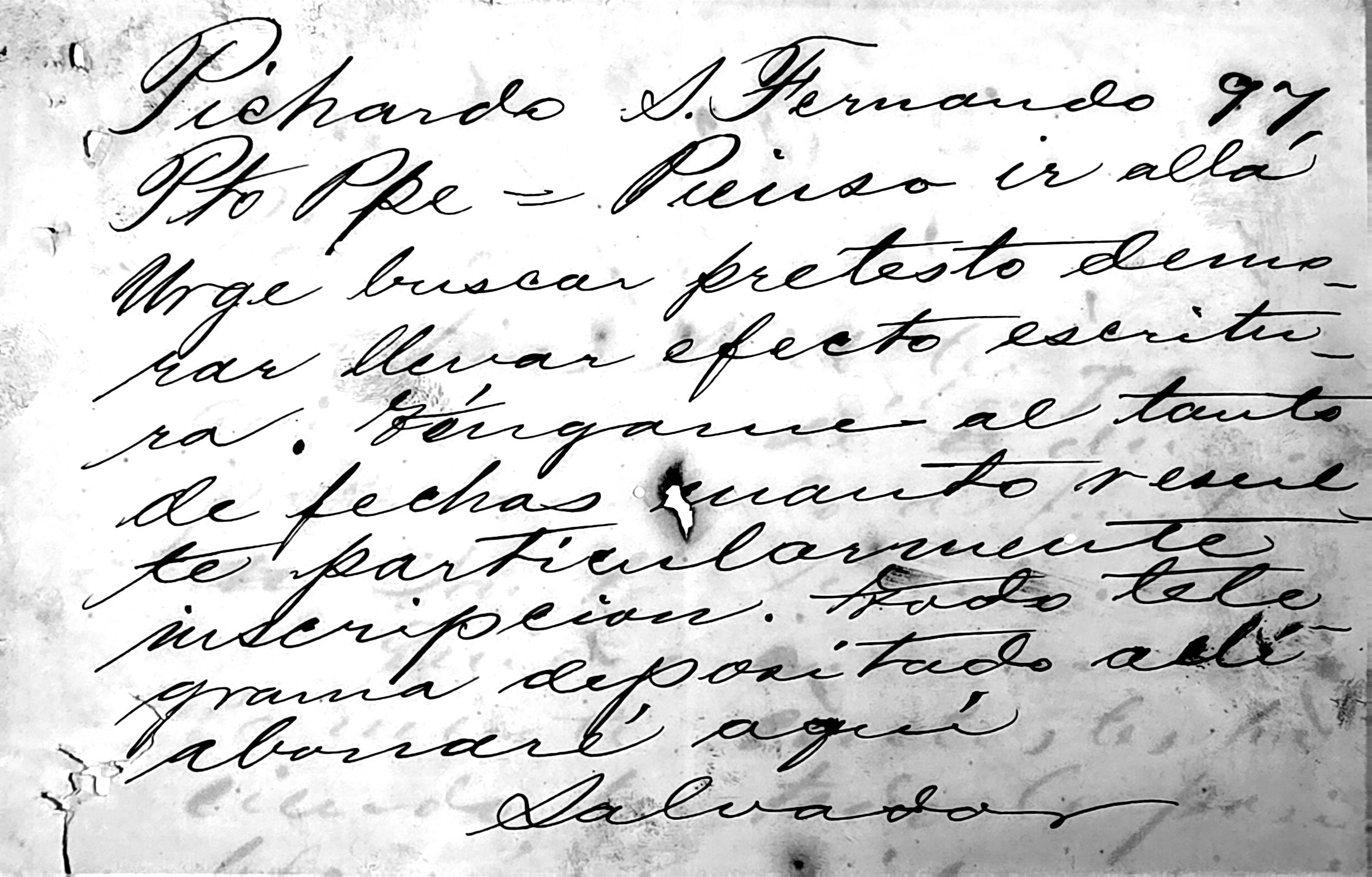
Step 2. Read the certain parts first. You don't start with the hardest word but with those you can read without doubt. Here they were the first line and the signature: «Pichardo», «S. Fernando 97», «Pto. Ppe.» and, at the end, «Salvador». Those words give clues to everything else: they show how that hand writes each letter, and each recognised letter helps decipher the next.
Step 3. Identify what kind of document it is. The first line is neither a greeting nor a date. It is a name, a street with a number and a city, followed by an «=» sign. That is the format of a telegraphic address: addressee, residence and town, then the message.
The rest confirms it. The sentences are short, without articles or courtesies, as people wrote when paying by the word. And the text ends by talking about telegrams: «Any telegram filed there I will pay for here». This is the text of a telegram, handwritten to be handed in at the telegraph office or as a draft.
Knowing what a document is changes how you read it. The «97», for example, could look like a year, 1897. But in a telegraphic address, after the street and before a comma, it is the house number. The document, in fact, is undated.
Step 4. Expand the abbreviations. Nineteenth-century documents are full of abbreviations, often with superscript letters. Here there were two: Pto. Ppe. = Puerto Príncipe, the historic name of Camagüey; and S. Fernando = San Fernando, a street name.
Other frequent abbreviations in the Cuban documents of our collection: V.S. / V.E. (Your Lordship / Your Excellency, in Captaincy General letters, 1851); «Dios gue. á V.S. m.s a.s» (May God keep Your Lordship many years, the usual official closing); Sor. / Sr. (Señor, Mr.); Sría. (Secretaría, Secretariat); P. y L. (Patria y Libertad, Homeland and Liberty, in Liberation Army documents, 1896); Campto. (Campamento, camp); M. G. / Gral. (Major General / General, in military signatures); Franco. (Francisco, in María Cabrales's receipt, 1898); vda. (viuda, widow, «María C. vda. Maceo»).
Step 5. Respect period spelling. The third line reads «buscar pretesto», with an s. It is not an error to correct: it is a common nineteenth-century spelling. A faithful transcription keeps the original spelling, neither modernising nor correcting it. To ease reading, a modernised version or a translation is added separately, but never mixed with the original.
Step 6. Mark the damage, don't invent. In the middle of the sheet there is a hole surrounded by a dark stain. It is corrosion from iron-gall ink, the usual ink of the period, which over the years turns acidic and can eat through the paper. The hole took part of a word.
From the context, «Téngame al tanto de fechas cuanto res[pec]te particularmente inscripción», the word must be «respecte». But the middle letters can't be seen, so they are written in square brackets. That is the basic convention of an honest transcription: brackets mark what the transcriber adds, and [illegible] or [?] mark what cannot be read. Inventing a word to make the sentence look nice is the fastest way to lose an expert reader's trust.
Step 7. The full text, and what it means. Transcription: «Pichardo S. Fernando 97, Pto. Ppe. = Pienso ir allá. Urge buscar pretesto demorar llevar efecto escritura. Téngame al tanto de fechas cuanto res[pec]te particularmente inscripcion. Todo telegrama depositado allí abonaré aquí. Salvador».
In today's language: the sender plans to travel to Puerto Príncipe; he asks Pichardo to find an excuse to delay the signing of a deed and to keep him informed of the dates, especially of the registration, presumably at the Property Registry; and he undertakes to pay for the reply telegrams. A property matter, urgent, handled at a distance.
The text also helps date it: the city is still called Puerto Príncipe, a name officially changed to Camagüey in the early twentieth century. The handwriting, paper and ink point to the late nineteenth century.
Step 8. Resist the temptation to attribute. Here comes the hardest part, and it has nothing to do with handwriting. A telegram to Puerto Príncipe signed «Salvador», about deeds and property, immediately brings to mind Salvador Cisneros Betancourt, the Camagüey marquis who renounced his title for independence, was twice president of the Republic in Arms and whose lands were confiscated and later partly returned. The story fits too well.
And precisely for that reason we do not claim it. «Salvador» is a common name; there is no surname, date or letterhead; and Cisneros normally signed with his surname. The only way to support that attribution would be to compare the handwriting with documents securely his. Until then it is a hypothesis, and we present it as such.
In the world of historical documents, the difference between «is by» and «could be by» is not a nuance: it is the difference between research and invention. Many documents have been misattributed because someone wanted them to be.
What a small sheet teaches us. This telegram won't change the history books. But a single sheet holds the whole method: look carefully, read what is certain, understand what kind of document it is, respect the original, mark the doubts and never ask the paper for more than it says.
That is how we work on every piece in the collection. And if you have a manuscript you can't read, this is a good place to start.
About this piece. The telegram is part of the CUVINTAGE collection. Do you know who lived at 97 San Fernando Street in Puerto Príncipe, or who this Pichardo was? Write to us.