The revolution's accounts: a receipt from the Cuban Revolutionary Party
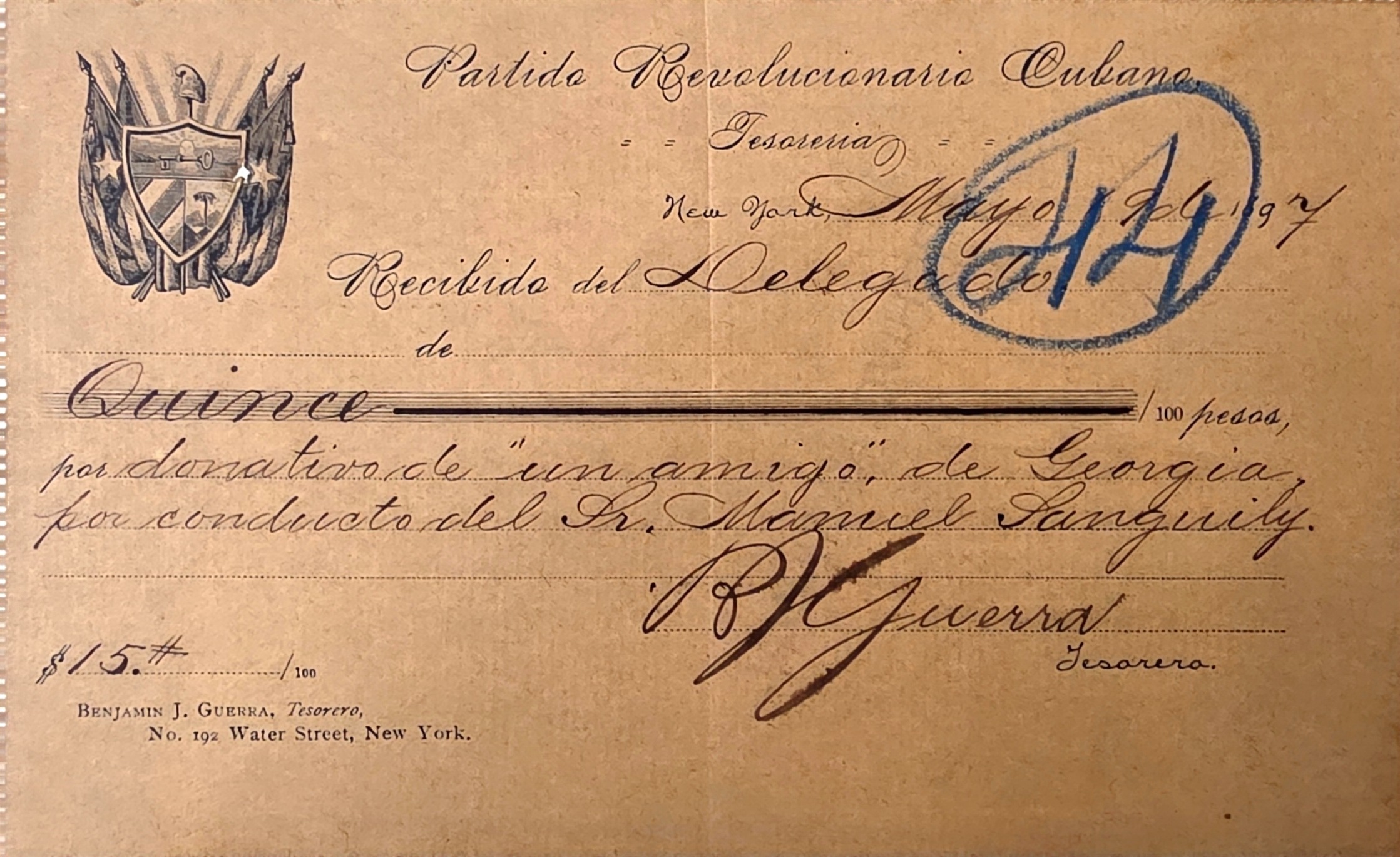
Fifteen pesos, an anonymous donor from Georgia and the signature of Martí's treasurer: an 1897 receipt opens the accounting books of Cuba's war of independence.
Wars are told through battles, but they are paid for with money. The war of 1895, the one Cuba fought for its independence, was largely financed from outside the island, peso by peso, thanks to thousands of emigrants. Few traces of that revolutionary economy remain, and this is one of them.
It is a printed form, bearing Cuba's coat of arms between lone-star flags, completed by hand in ink: «Cuban Revolutionary Party – Treasury. New York, May [20?] 1897. Received from the Delegate Fifteen /100 pesos, as a donation from “a friend”, of Georgia, through Mr. Manuel Sanguily. B. J. Guerra, Treasurer. $15.—/100». In just a few lines, three names from Cuban history appear, plus a fourth who chose to have none.
A party with a treasury. José Martí founded the Cuban Revolutionary Party in 1892 with a clear idea: the war could not be improvised. Before a single shot was fired, organization, discipline and funds were needed. The Party grouped the patriotic clubs of the emigration —in New York, Tampa, Key West, the Caribbean and Central America— and gave them a common structure. Within that structure, the treasury was a central piece. On April 10, 1892, Benjamín J. Guerra was elected treasurer, and he held the office until the Party was dissolved at the end of the war.
Benjamín Guerra, Martí's treasurer. Benjamín J. Guerra Escobar was born in Puerto Príncipe (Camagüey) in 1855. In New York he made a name for himself in the tobacco trade, at the firm Barranco Brothers, and achieved a comfortable position. His relationship with Martí was more than political: they shared a fraternal friendship, and in 1891 Martí asked him to give free evening arithmetic classes to Cuban and Puerto Rican workers at La Liga, the educational society Martí had founded in New York. He was the profile the Party needed: a man of numbers and absolute trust. Guerra died in Philadelphia in January 1900, a few months after the end of the war to which he had devoted his accounts. The form remembers him in its imprint: «Benjamin J. Guerra, Treasurer, No. 192 Water Street, New York». The treasurer's name, printed on every receipt, was also a guarantee for whoever handed over the money.
The Delegate: Estrada Palma. The receipt says «Received from the Delegate». In the Party's terminology, the Delegate was its highest authority. Martí held the role until his death at Dos Ríos in May 1895; afterwards, the office passed to Tomás Estrada Palma, who in 1897 directed the movement's diplomacy, propaganda, expeditions and funds from New York. The receipt therefore documents an internal movement: money that had reached the Delegate passes to the Treasury and is recorded. It is accounting in the most literal sense.
Manuel Sanguily and “a friend” from Georgia. The money did not come from the Delegate, but from a donor who asked to appear only as “a friend”, from Georgia, and who sent it “through Mr. Manuel Sanguily”. Manuel Sanguily (1848–1925), a veteran of the Ten Years' War, did not fight in the 1895 war: he spent those years exiled in the United States as a journalist and orator for the cause. In May 1896 he spoke at Chickering Hall in New York, on the first anniversary of Martí's death. After independence he became a senator, Secretary of State and president of the Cuban Senate.
The donor, on the other hand, is a mystery. Georgia was not a center of Cuban emigration like Florida or New York, and the anonymity suggests an American sympathizer. In those years, the cause of “Cuba Libre” won supporters across the United States; at CUVINTAGE we have another example, a letter sent to Estrada Palma in 1898 from a pro-Cuba league in Dallas, Texas.
Many small sums make a war. Fifteen pesos did not buy an expedition. But the Party was not financed by great fortunes, rather by thousands of small, steady contributions: club dues, collections, private donations and, most notably, the contribution of Cuban cigar workers in Tampa and Key West, who gave part of their wages to the cause. Those contributions were acknowledged with papers like this one. Certificates of “Patriotic Donation for the War Funds” of two dollars, issued by the Party's local body in Tampa in 1895, are still preserved. Every receipt, however small, served to give confidence to the giver and control to the administrator.
Income and expenses: two receipts from the same series. Above the date of this receipt, someone later wrote, in blue pencil and inside a circle, the number 44. It is the same mark that appears on another document in our collection: the receipt with which María Cabrales, widow of Antonio Maceo, acknowledged in April 1898 the payment of her pension at La Mansión, Costa Rica, “by order of the New York Delegation”. Together they show the two sides of the revolution's accounts: the money that came in, as donations, and the money that went out, to support the families of those who had fallen. The blue numbering suggests that both were part of a series of accounting vouchers of the Delegation. Institutions such as the University of Miami's Cuban Heritage Collection hold Party payment vouchers from 1898 and 1899 of the same kind.
What we still don't know. The exact date: the blue number covers the day; the most likely reading is May 20, 1897. The Georgia donor: “a friend” is all the receipt says, and probably all he wanted to say. The number 44: what accounting series it was and who numbered it remains open. If you know of other Cuban Revolutionary Party receipts with blue-pencil numbering, we would very much like to compare them.
About this piece. The receipt is part of the CUVINTAGE collection and is for sale. Also read our article about the receipt of María Cabrales, widow of Antonio Maceo.
Sources: Casa Vitier García Marruz, “Benjamín J. Guerra Escobar”; Revista CCuba, “La Tesorería del Partido Revolucionario Cubano (1892-1895)”; Wikipedia, “Manuel Sanguily Garritte”; EcuRed, “Partido Revolucionario Cubano”; University of Miami, Cuban Heritage Collection, CHC0347; Todocoleccion: donation certificate of the Cuban Revolutionary Party, Tampa, 1895.